Faith & the Word · Forgiveness & Guidance
Remember Me in the Light of Your Love
“Remember me in the light of your unfailing love, for you are merciful, O Lord.”
Psalm 25:7 NLT
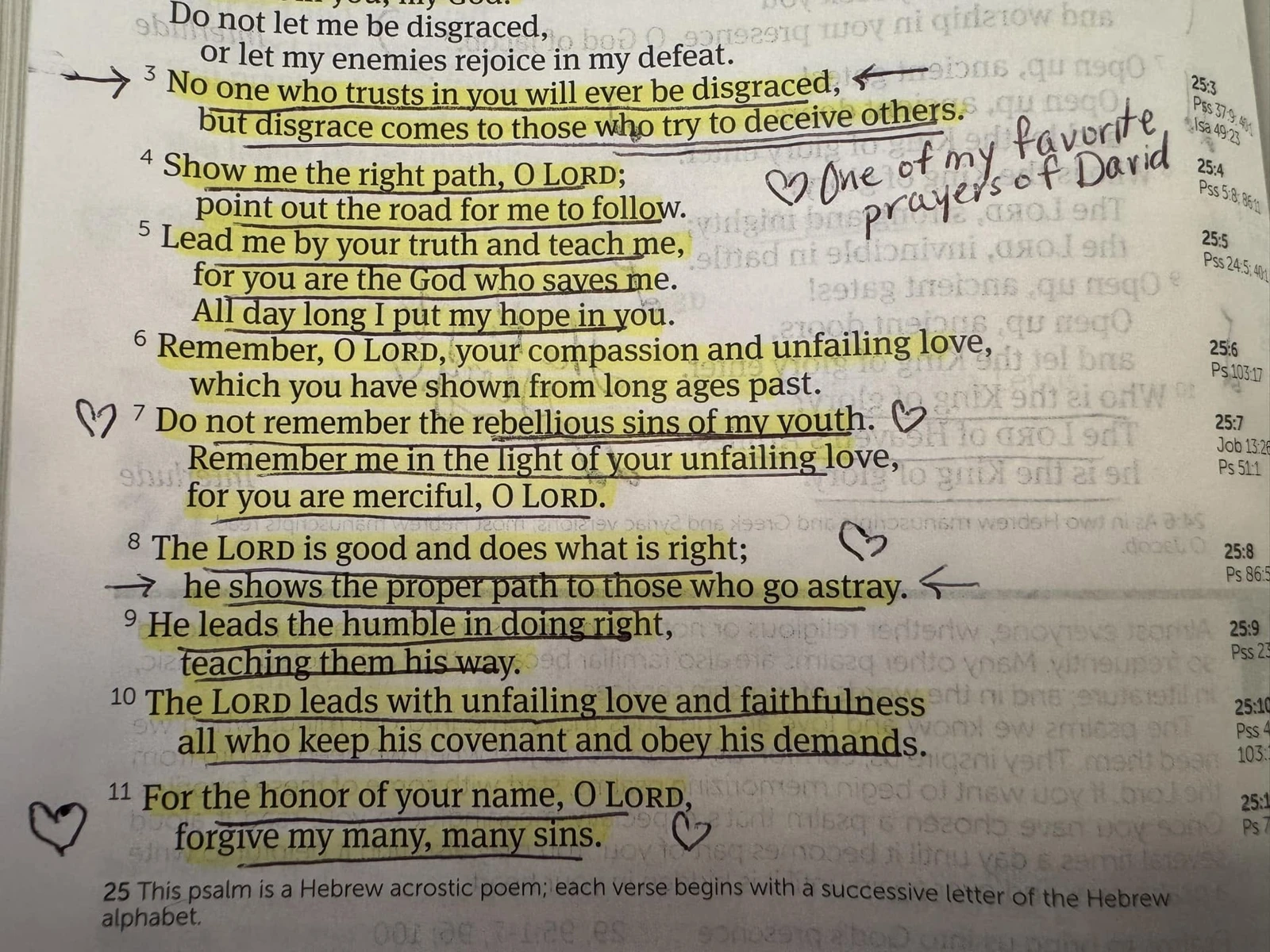
I find Psalm 25 to be so deep and meaningful. It’s often hard for me to read it without a swelling of tears. Imagine David, now much older and wiser, reflecting on his life's journey and the consequences of his sin, sitting down to pen these words…
O Lord, I give my life to you. I trust in you, my God! Do not let me be disgraced, or let my enemies rejoice in my defeat. No one who trusts in you will ever be disgraced, but disgrace comes to those who try to deceive others.
Show me the right path, O Lord; point out the road for me to follow. Lead me by your truth and teach me, for you are the God who saves me. All day long I put my hope in you.
Remember, O Lord, your compassion and unfailing love, which you have shown from long ages past. Do not remember the rebellious sins of my youth. Remember me in the light of your unfailing love, for you are merciful, O Lord.
The Lord is good and does what is right; he shows the proper path to those who go astray. He leads the humble in doing right, teaching them his way. The Lord leads with unfailing love and faithfulness all who keep his covenant and obey his demands.
For the honor of your name, O Lord, forgive my many, many sins. Who are those who fear the Lord? He will show them the path they should choose. They will live in prosperity, and their children will inherit the land. The Lord is a friend to those who fear him. He teaches them his covenant. My eyes are always on the Lord, for he rescues me from the traps of my enemies.
Turn to me and have mercy, for I am alone and in deep distress. My problems go from bad to worse. Oh, save me from them all! Feel my pain and see my trouble. Forgive all my sins. See how many enemies I have and how viciously they hate me! Protect me! Rescue my life from them! Do not let me be disgraced, for in you I take refuge. May integrity and honesty protect me, for I put my hope in you.
O God, ransom Israel from all its troubles.
Psalm 25:1–22 NLT
In Psalm 25, we find David pouring out his heart before God, seeking forgiveness, guidance, and restoration. I find there to be such profound sentiments behind David's plea.
In verse 7, David implores, “Remember not the sins of my youth.” Here, the Hebrew word for “remember” is “zakar.” In the context of his prayer, David's concern goes beyond mere recollection. He is appealing for mercy, asking God to act upon His steadfast love rather than hold his youthful sins against him.
David further proclaims, “According to your steadfast love, remember me.” The Hebrew term for “steadfast love” is “chesed,” which encapsulates God's unfailing, covenant-keeping love. It is His loving-kindness and faithfulness that sustain us and form the foundation for David's plea. He acknowledges his shortcomings, but pleads that God's unfailing love would be the lens through which his life is remembered.
As David's plea continues, he expresses his genuine desire for guidance and instruction. He longs for God to make known to him His ways and to teach him His paths (verse 4). In verse 8, David declares, “Good and upright is the Lord; therefore, he instructs sinners in the way.”
The Hebrew word for “instruct” is “yarah,” meaning to teach or direct. The same root can also refer to shooting or throwing, bringing to mind the image of an archer aiming at a target. David recognizes God's goodness and uprightness, and he earnestly seeks the Lord's guidance, knowing that God is willing to show sinners the right path.
In verses 9–10, David acknowledges that God leads the humble, teaching them His way, and that the Lord's paths are marked by unfailing love and faithfulness for those who keep His covenant. Later, in verse 16, David pleads, “Turn to me and have mercy.” The Hebrew word behind this appeal is “chanan,” meaning to show favor or be gracious. David appeals for God's mercy, knowing that his sins are many, yet trusting in God's willingness to forgive.
David's plea reaches its climax in verses 11–15, where he emphasizes the intimate relationship God seeks with those who fear Him. He meditates on the Lord's faithfulness, for God promises to reveal His secrets to those who fear Him, to make known His covenant.
Within this vulnerable reflection, David highlights God's character while acknowledging his own frailties. He emphasizes God's forgiveness, guidance, and desire to restore those who have gone astray. In these words, I hear a heart full of gratitude for God's ability to forgive, redirect, and transform lives.
As we reflect on David's plea, I pray we can all find comfort in the assurance that God's love and mercy abound. His unfailing love stands as a beacon of hope, reminding us that no matter our past mistakes or the weight of our sins, God remembers us through the lens of His everlasting love. May we, in humility, seek His forgiveness, guidance, and restoration, knowing that He is the one who teaches, forgives, and lovingly leads us on the path of righteousness.
Misti Rains Kantor
Newer reflection: A Melody of Surrender
Earlier reflection: The Hidden Places of the Heart
Return to The Morning Mist