Faith & the Word · Humility & Surrender
The Hidden Places of the Heart
“May these words of my mouth and this meditation of my heart be pleasing in your sight, Lord, my Rock and my Redeemer.”
Psalm 19:14
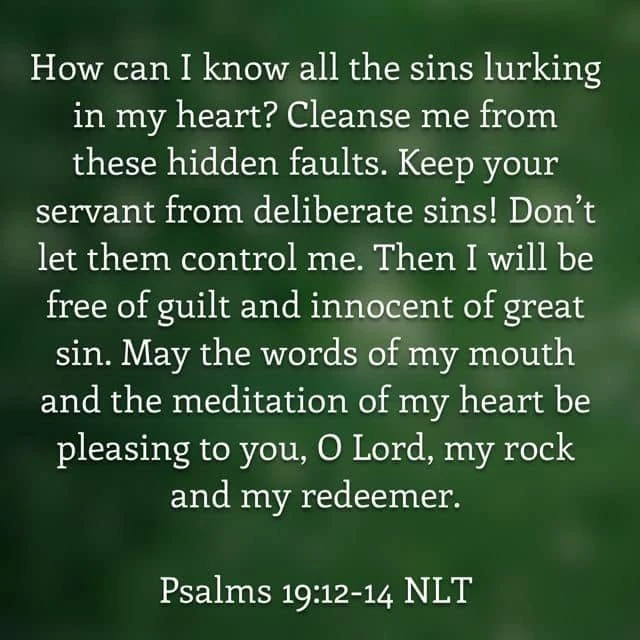
12 Who can discern their own errors?
Forgive my hidden faults.13 Keep your servant also from willful sins;
may they not rule over me.
Then I will be blameless,
innocent of great transgression.14 May these words of my mouth and this meditation of my heart
Psalm 19:12–14
be pleasing in your sight,
Lord, my Rock and my Redeemer.
In the sacred words of Psalm 19:12–14, King David humbly acknowledges the limitations of human understanding and the deeply rooted nature of sin. He reaches out to God, recognizing the need for forgiveness and the desire to be blameless. This beautifully crafted prayer resonates with infinite wisdom and provides a thought-provoking journey into the depths of our hearts.
In verse 12, David asks, “Who can discern their own errors?” The Hebrew word used for “errors” here is “shegi’ot,” from “shegi’ah,” meaning an error or mistake, related to the root “shagah,” meaning to wander or go astray. David acknowledges that our human understanding is inherently limited and prone to wander, making it difficult for us to see all our own errors. It is an admission that we often need divine intervention to reveal the hidden faults within us.
In verse 13, David pleads, “Keep your servant also from willful sins.” The Hebrew word “zedim” carries the sense of pride or presumption; in this context, it points to willful, presumptuous sins. David recognizes the potential for sin to gain control over him. He longs for God's guidance and strength to resist the allure of rebellion and live a blameless life, innocent of great transgression.
In verse 14, David concludes, “May these words of my mouth and this meditation of my heart be pleasing in your sight.” Here, the Hebrew word for “pleasing” is “ratsown,” meaning acceptance, favor, or delight. David acknowledges the significance of both his spoken words and the thoughts that occupy his mind. He longs for them to mirror God's desires and bring delight to the One who is his Rock and Redeemer.
This passage serves as a profound reminder of our human frailty, the need for God's forgiveness, and the yearning to live a blameless life. The intricate choice of words by David guides us to reflect on the hidden aspects of our hearts, urging us to bring our inward struggles before the Creator.
I was challenged this morning by this beautiful Psalm to embrace the humility displayed by David in this psalm. May we ask God to illuminate the hidden faults within us, to guard us against deliberate rebellion, and to reshape our thoughts and words to align with His divine will. For in this surrender, we find the transformative power of God's grace, enabling us to live blameless lives that honor our Redeemer, our Rock.
Misti Rains Kantor
Newer reflection: Remember Me in the Light of Your Love
Earlier reflection: Our Words Matter 🗣💥
Return to The Morning Mist